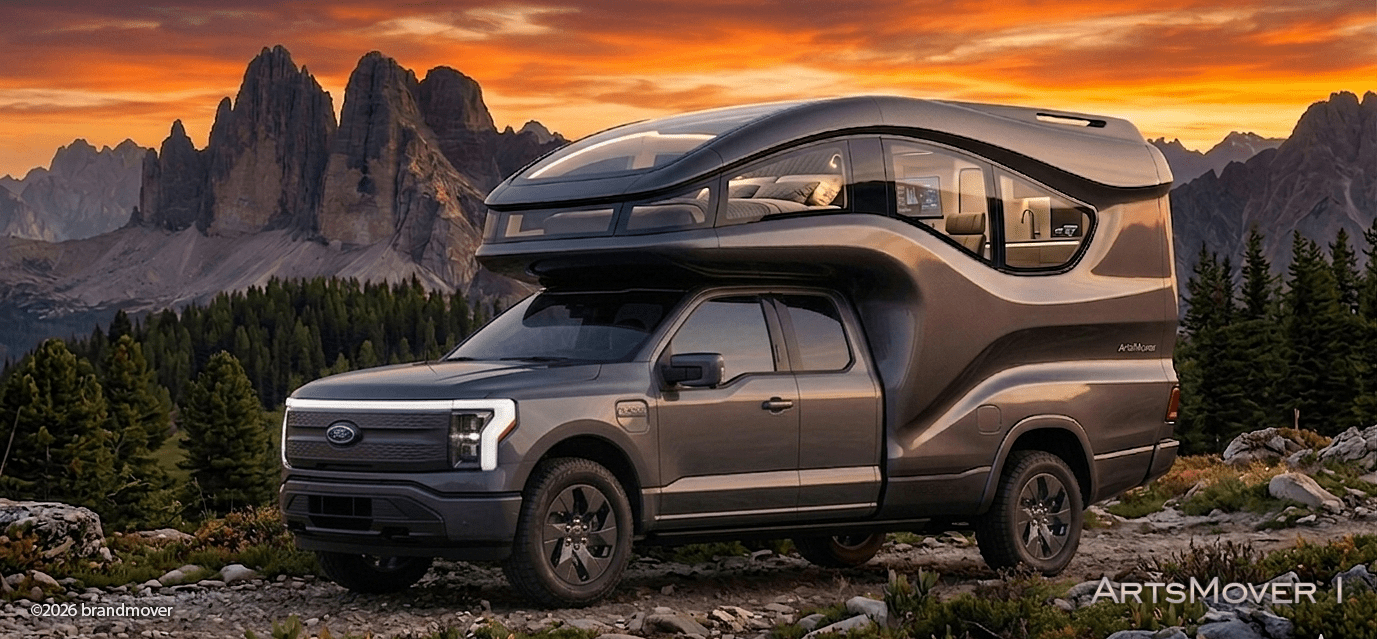

ArtsMover is a lightweight truck camper designed as an alternative to traditional Class C motorhomes, built around a single constraint: a collapsed roof height under 8 feet. This allows the unit to fit in standard garages, parking structures, and urban spaces, while the camper detaches from the truck in under 10 minutes.
The 2026 model weighs under 1,500 lbs, supports EV half-ton trucks like the F-150 Lightning, and includes a 5,000Wh lithium battery bank, induction cooktop, and Starlink pre-wiring. Priced between $45,000 and $70,000 as a full setup, it is positioned against Class C RVs that start above $80,000 and depreciate significantly in their first year.
ArtsMover – The Camper That Kills
the Big RV Lie
ArtsMover isn’t a trend. It’s physics, economics, and the end of paying $80K to stay in a parking lot.
For 50 years, the RV industry has sold you one story: bigger is better. More slide-outs. More square footage. More everything — except the places you can actually reach.
You’re Paying More to Go Less Far
A traditional Class C motorhome averages 8–12 MPG. It can’t navigate mountain switchbacks, won’t fit down the forest road to the campsite you bookmarked, and loses 30% of its value the moment you drive it off the lot.
You end up at an RV resort, 200 miles from home, plugged into utilities, surrounded by other people who also thought this was freedom.
“Most RVs are designed for campgrounds. ArtsMover is designed for everywhere else.”
One Constraint That Changes Everything
ArtsMover starts with a single design rule: with the roof collapsed, the total vehicle height stays under 8 feet. That one decision unlocks a completely different life on the road.
- Fits in your home garage — no $200/month storage fees
- Clears drive-thrus, parking garages, low bridges
- Parks in any standard space, any city, any trailhead
- Camper detaches in under 10 minutes — the truck stays a truck
- Weight centered low over the axles — the physics behind a 20-year lifespan
A Luxury Studio at Under 1,500 lbs (680kg)
Raise the pop-top: full standing height, queen memory-foam bed, 360° screened ventilation — without losing one square foot of floor space below. In winter, stay collapsed and sleep low where the heat collects. In summer, open to the stars. The design works with the environment instead of fighting it.
The Gap Between 3 Days and 3 Weeks
The 2026 Truck Camper of the Year — the Outpost 6.5 — ships propane-free with a 5,000Wh lithium battery bank, induction cooktop, 3,600W inverter-charger, and Starlink pre-wiring as standard. This is the new baseline.
ArtsMover matches this with aerospace-grade composite panels under 1,500 lbs, making it fully compatible with EV half-tons like the F-150 Lightning without destroying range. Your adventure platform becomes your daily driver.
“Energy efficiency isn’t a feature. It’s the foundation of freedom travel.”
ArtsMover vs. Class C — Not Even Close
Class C RV
- Drives like a school bus
- 8–12 MPG highway
- Can’t go off-road
- Starts at $80K+
- 30% depreciation, year 1
- Needs dump stations
- Breaks down at 40,000 miles
ArtsMover
- Drives like a real truck
- EV-capable platform
- Goes where 4WD goes
- $45–70K full setup
- Truck retains resale value
- Cassette toilet, no tanks
- Built to survive 200K miles
Real trade-off: ArtsMover is built for 1–2 adults, or 2 adults + 1 child. For families who need more space, slide-out configurations start at $50K. But for couples and solo travelers who want real freedom? This is the smartest investment on the road.
What You Actually Pay
(depreciates fast)
(truck holds value)
The RV industry’s dirty secret: a Class C depreciates like a car but breaks like a boat. Most need major repairs by year five. Camper trucks outlive them by a decade — because truck platforms are engineered to 200,000+ miles. You’re not buying a product. You’re buying a platform.
Why Camper Trucks Outlive RVs by 15 Years
Traditional RVs stack weight high and unevenly — heavy water tanks, appliances, and structure all fighting the center of gravity. The result is body roll, constant suspension wear, and handling that makes mountain roads terrifying.
ArtsMover places water, batteries, and weight low — directly over the axles. The physics are simple: less roll, less wear, better fuel economy, better off-road stability. It’s the difference between a rig that fails at 40,000 miles and one that reaches 200,000.
The Market Confirms What You’re Already Feeling
The truck camper market is growing at 4.31% annually toward $6.4 billion by 2032. The fastest-growing segment? Ultra-light pop-ups under 1,500 lbs — exactly ArtsMover’s weight class. Manufacturers are now offering modular “shell” systems where kitchen, solar, and storage units can be added or removed as your journey evolves.
Carbon fiber frames. Aerospace composite panels. Propane-free electrical systems. Electric remote jacks that load the camper in 30 seconds. The technology has finally caught up with how people actually want to travel.
This Is How We Travel Now
We’ve stayed in RV parks with neighbors eight feet away, sewer hookups, and a view of someone else’s awning. We’ve done the school-bus drives on mountain roads, white-knuckling it while the slide-out creaks.
Then we woke up at 5:50am in a mountain meadow with no one around, coffee already warm on the induction plate, rear window open to a view no campground reservation can sell you.
That’s the ArtsMover philosophy — and it’s the Vellyway philosophy. Go where the road ends. Stay until the story pulls you somewhere new. Leave nothing but tire tracks.
“This isn’t minimalism for its own sake. It’s choosing a rig that matches how you want to live — not how a dealership needs you to live.”
Build Your 2026 Adventure Platform
We’re dropping our first ArtsMover itinerary guide — remote routes, off-grid campsites, and setup checklists for couples and solo explorers. Free for subscribers.
→ Get the Free Itinerary GuideOr DM us on Instagram / LinkedIn @vellyway — tell us where you want to go.