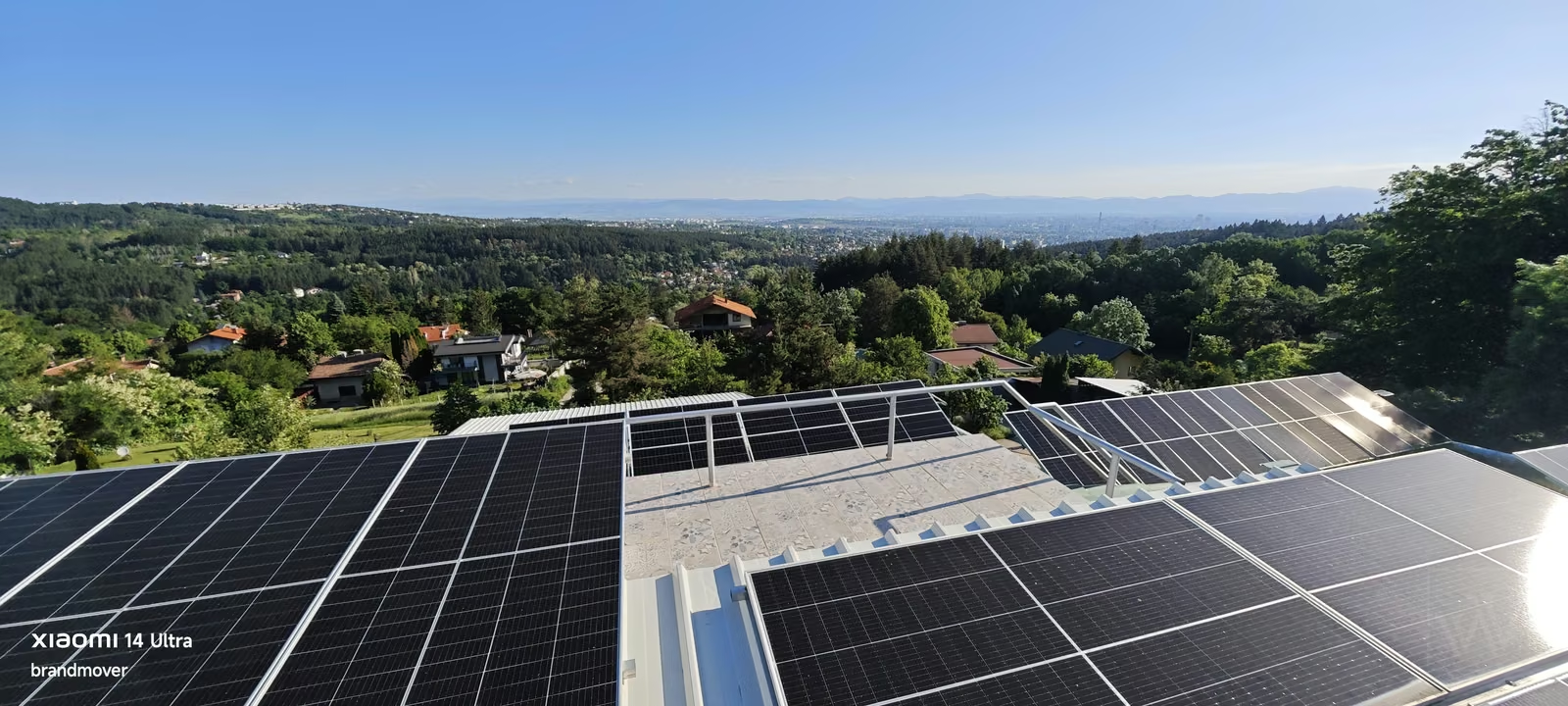
A 25 kW rooftop array near Sofia (SolarEdge SE25K, 48×510W). Owner expected ~25 kW, saw ~15kW?
We didn’t add a single panel. We found +32% by reading the data, not guessing.
Here’s the actual engineering, in plain English...
Solar Diagnostic — straight from the API
AuraOS pulled the site live (site metadata, inventory, 15-min power, and 5-min inverter telemetry) and rebuilt it as a digital twin from 8,750 hourly records.
- SE25K (25 kW AC) · firmware 4.21.511
- 31 of 33 optimizers connected — 2 quietly unpaired
- No smart meter, no battery — the site was flying blind on consumption/export
- 2025 production ≈ 23,430 kWh — actually above the design model. So this was never an annual-energy failure. It was a peak-power problem.
⚡ The main culprit — grid over-voltage curtailment (“Volt-Watt hunting”)
- On 21 June (clear) the inverter swung between 4 kW and 19.6 kW every 15 minutes, all afternoon.
- It stayed in MPPT the whole time (never tripped to FAULT), and the 750 V DC bus was rock-steady → not a hardware, string, or thermal fault.
- Every power collapse lined up with AC phase voltage spiking to 244–250 V (nominal 230 V → grid limit +10 % / 253 V).
- Mechanism: a weak, high-impedance grid connection. When the inverter pushes ~20 kW, its own export lifts the local voltage to ~250 V → the grid-code Volt-Watt function (EN 50549) throttles power to protect the line → voltage drops → inverter ramps back up → voltage rises again → oscillation.
A textbook feedback loop. The same weak grid causes the winter L3 under-voltage trips (185–192 V) → high impedance, both directions.
📅 Seasonal performance — the stat that proves it
- Peak month: June 2025, 3,509 kWh.
- 21 June (longest day) made 104.8 kWh — LESS than a clear day in March (107.7 kWh). A healthy summer array beats March by 30–40 %. Only curtailment does that.
- March 15: a textbook smooth bell curve, clean 16.5 kW peak. Summer: chaos.
- Jan 2026: 451 kWh vs Jan 2025: 922 kWh (−51 %) → undetected winter downtime.
🌑 Shading, 🌡️ temperature, 🔌 ohmic — the loss waterfall
- Nominal 27,609 kWh → array DC 22,495 kWh = 18.5 % DC loss. Breakdown:
- Shading / electrical mismatch: 3,700 kWh (13.4 %) — the big one, from the mixed 90°/23°/6° geometry.
- Temperature: 388 kWh (1.4 %) annually — but instantaneously −13.6 % at 65 °C cells on hot afternoons.
- Ohmic (DC wiring): just 115 kWh (0.4 %) — 6 mm² copper holds drop to 0.38 %. A minor lever; we didn’t over-invest here.
🧭 Geospatial & reflections
- At 42.65° N, the optimal fixed angle is ~37°, due South. Annual plane-of-array (clear-sky index):
- 90° vertical row → 1,770 (only 72 % of optimal)
- 23° movable bank → 2,359 (96 % — already near-perfect for summer)
- 6° near-flat bank → 2,074 (84 %, and below the 15° self-cleaning rain/snow threshold)
- Summer-optimal ~22°, winter-optimal ~58°.
On the E-W “Gaussian wing” idea: spreading panels east/west doesn’t raise raw annual energy (−0.6 % POA) — but it flattens the midday peak, which is exactly what stops the over-voltage trigger, and it harvests the sunrise/sunset shoulders the south-locked array wastes.
Plus rear-side reflection/albedo upside if the vertical row goes bifacial.
🛠️ Inverter & optimizer optimization
- Pair the 2 sleeping optimizers (31 → 33).
- Re-balance the strings (monitoring showed ~30 of 48 modules loaded on one string).
- Widen the Volt-Watt band / over-voltage set-points (with DSO sign-off) and open a grid ticket for a transformer tap or heavier service conductor.
- Add a smart meter + DC-coupled battery (or V2H EV) to bank the midday surplus the grid currently rejects — capturing it and lowering local voltage so the inverter stops self-throttling.
📈 The Yield Path (annual, baseline ≈ 23,400 kWh)
| Action | +kWh/yr | +% | Type |
|---|---|---|---|
| Stop summer grid over-voltage curtailment | 1,900 | 8.1 % | Config / DSO |
| Re-rack 22 near-flat panels 6° → ~22° | 1,100 | 4.7 % | Physical |
| Pair 2 optimizers + re-balance strings | 900 | 3.8 % | Logical |
| Seasonal winter tilt on 19 movable (23° → 55°) | 700 | 3.0 % | Physical (2×/yr) |
| Recover winter downtime (Jan-type faults) | 600 | 2.6 % | Maintenance |
| Summer panel cooling (peak hours) | 500 | 2.1 % | Thermal |
| Subtotal (no storage) | 5,700 | 24.4 % | |
| + Battery / V2H captures rejected surplus | 1,500–2,000 | 6–8 % | Storage |
| TOTAL ACHIEVABLE | ~7,500 | 30–32 % | ✓ target met |
On the specific summer-afternoon days that created the “15 kW” perception, peak-power and daily-energy recovery run far higher than the annual average — those days alone can improve 40–60 %.
Most underperforming solar isn’t broken. It’s misread.
That’s what we do at GodRa: Consultation · Installation · Optimization.
👉 [Book a GodRa audit]